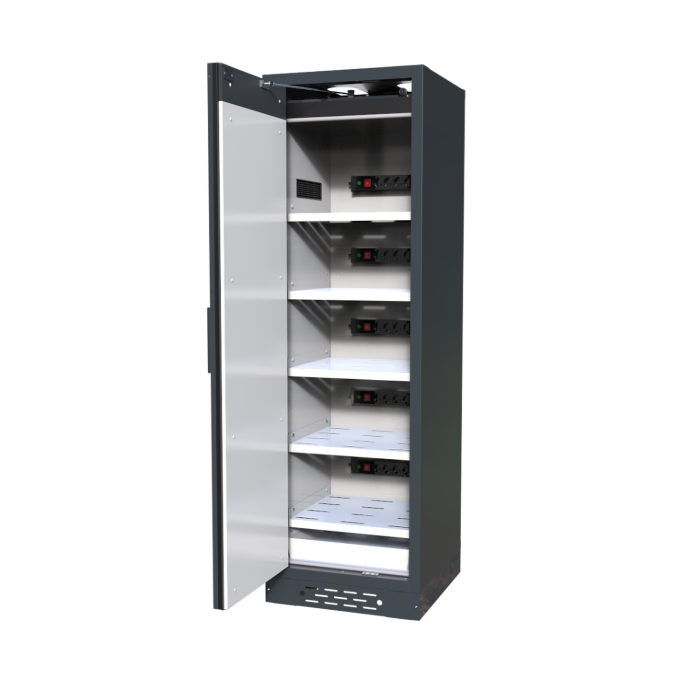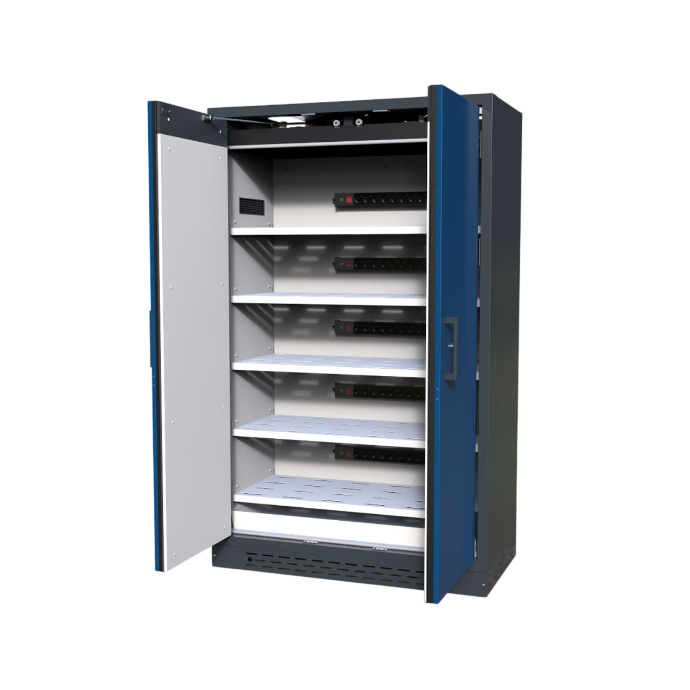

Certified cabinets for charging and storing lithium batteries.

Ensure the safe charging of lithium batteries through flexible leasing or direct purchase. We conduct a free preliminary audit and assess the risks and ways to mitigate them using our systems.​

Request a free audit

Why does your company need a cabinet for lithium batteries?


Lithium batteries are now present in almost every professional environment (power tools, e-bikes, portable equipment, maintenance…). The problem is that a failure, impact, overcharge, or damaged battery can turn the charging/storage area into a risk point for people, facilities, and business continuity. That’s why insurers and safety organizations recommend specific measures, such as fire-resistant cabinets (Type 90) and/or physical separation of battery areas, to minimize damage and prevent accidents.


We solve it like this:​


1.  You charge and store batteries in a controlled and protected space.

2. You eliminate risk in areas with multiple batteries or with damaged/defective batteries.

3.  We help you define the right solution with a free preliminary audit. 

4.  Through our LEASING system, it represents a minimal cost for the company.

5.  Or, if you prefer, you can BUY it at a very competitive price.


How does our service work?

It is a lease of movable assets with a final purchase option.

1. Free Initial Audit

We conduct an initial audit for our clients to assess risks in accordance with current regulations (1).

2. Audit and Offer Presentation

We present the audit to the client and provide a value proposal for leasing our equipment.

3. Leasing or Sales Contract

Signing of the leasing or sales contract for our equipment with the client (2).

4. Installation and Maintenance

We install our equipment and provide maintenance for it. If it’s a lease, maintenance is included in the price (3).

What does the Free Audit consist of?

Objective


To verify that the installation and use of lithium battery charging/storage cabinets are carried out with an adequate level of safety and in compliance with applicable regulations (fire, electrical, occupational safety, and product safety).

Phases


  1. Start and scope: what is stored/charged, where, quantities, user profiles, schedules, integration with the building’s fire protection system (PCI).
  2. Document review: equipment certificates, manuals, maintenance, risk assessment, and procedures. 
  3. On-site inspection: physical verification of the location, electrical installation, signage, access, ventilation, and surroundings.

Functional tests (without destructive testing): alarms, sensors, emergency stop, communications, ventilation/extraction, operation of protection systems integrated or connected to the building.

  1. Report and action plan: findings, non-conformities, risk/priority, corrective measures, evidence, and deadlines.
  2. Follow-up: verification of corrections and closure.

The exact regulations depend on the type of building/activity: industrial (updated RSCIEI) or construction (CTE DB-SI), as well as REBT, RIPCI, and occupational health and safety (PRL). 

What is checked? 


1) Location and passive protection

  • Location (dedicated area), access, aisles, organization, and cleanliness.
  • Separation of combustible materials, control of nearby ignition sources.
  • Environmental conditions: ventilation, temperature, humidity; manufacturer limitations.

2) Electrical installation (safety and compliance)

  • Dedicated line, protections (circuit breaker/differential), wiring sizes, conduits, grounding.
  • Overload protection and coordination with the actual charging power.
  • Panels, electrical signage, and commissioning verification.

3) Active fire protection (of the equipment and the building)

  • Detection/alarms (local and/or connected to a central system), notifications, and escalation.
  • First response means (appropriate fire extinguishers, accessibility, signage) and risk compatibility..
  • If there are fixed/automatic systems: design, installation, and maintenance in accordance with RIPCI..

4) Daily operations and risk management

  • Battery classification: new / in use / damaged / "in quarantine".
  • Admission criteria: impacts, swelling, leaks, abnormal temperature, history.
  • Charging rules: permitted chargers, SOC limits if applicable, supervision, prohibitions.
  • Management of damaged batteries and waste (segregation, temporary storage, authorized handler when applicable).

5) Occupational health and safety (OHS), training, and emergency procedures

  • Risk assessment and preventive measures (training, instructions, PPE if applicable).
  • Emergency procedure: what to do in case of smoke/alarm/temperature, evacuation, calling emergency services, electrical isolation.
  • Compliance as a “work equipment” and checks/maintenance.

6) Maintenance, inspections, and records

  • Maintenance plan (cabinet + fire protection system + electrical): schedules, reports, incidents, corrective actions.
  • Record of alarms, events, interventions, and inspections.
Our Storage Systems

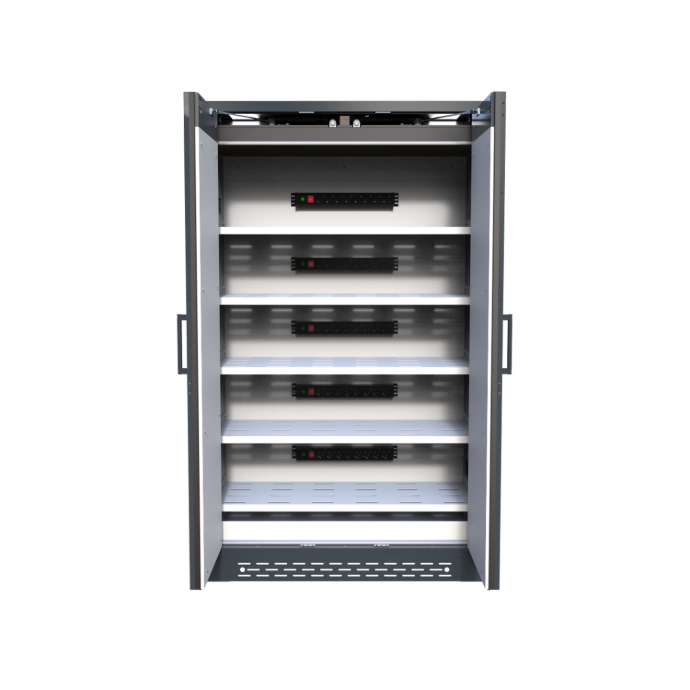
BatPro 9120MAX

Type 90 Cabinet (90 minutes) with high capacity for safe storage and/or controlled charging of lithium batteries in professional environments. Designed to centralize large volumes of batteries and reduce risk in warehouses, workshops, industry, and logistics.

Certifications: Type 90 (UNE-EN 14470-1), tested according to EN 1363-1 curve + VDMA 24994 for lithium batteries.

Ideal for: operations with many batteries, recurring charging areas, e-commerce, industrial maintenance.

Download Technical Sheet

BatPro 9060 MAX

Type 90 (90-minute) cabinet, compact/medium, for companies that need a certified solution but with a smaller footprint than the 9120. Maintains the objective: protecting people and facilities while organizing battery operations.

Certifications: Type 90 (UNE-EN 14470-1), tested according to EN 1363-1 curve + VDMA 24994 for lithium batteries.

Ideal for: workshops, technical services, hospitals/facilities with battery-powered tools, small charging areas.

Download Technical Sheet

BatPro 9060S MAX

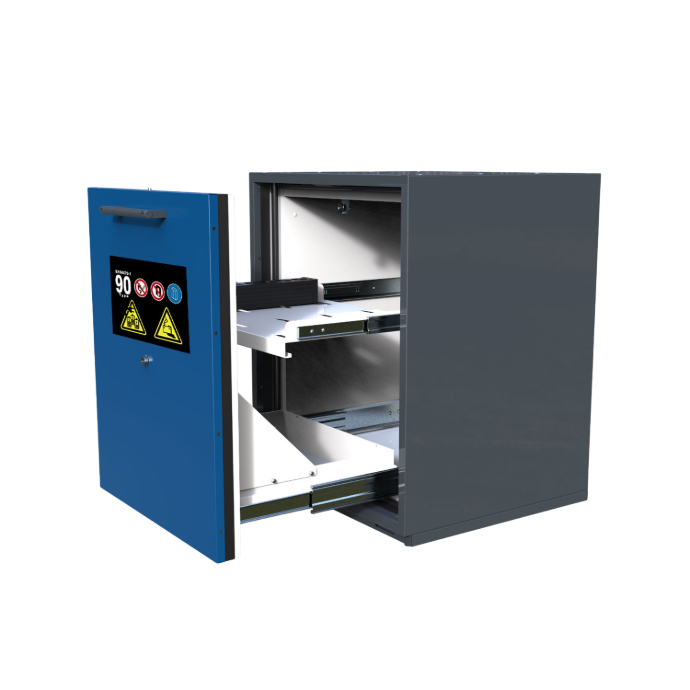
Under-bench Cabinet (Type 90) for quarantine, designed to isolate damaged, defective, or suspicious batteries outside the normal circuit. It is not a “charging” cabinet; it is a safe point for containment and risk management while deciding on removal, diagnosis, or disposal. 

Certifications: Type 90 (UNE-EN 14470-1), tested according to EN 1363-1 curve + VDMA 24994 for lithium batteries.

Ideal for: after-sales service (SAT), reverse logistics, maintenance, recycling/waste management, any company experiencing battery incidents.

Download technical sheet

Contact us so we can evaluate your risk for free.

We conduct a free risk audit of your business.

Some of our clients.

We are in good company.